Monday, July 18, 2011

1 Trillion Is Spent on Welfare, Congress Should Cut Spending There

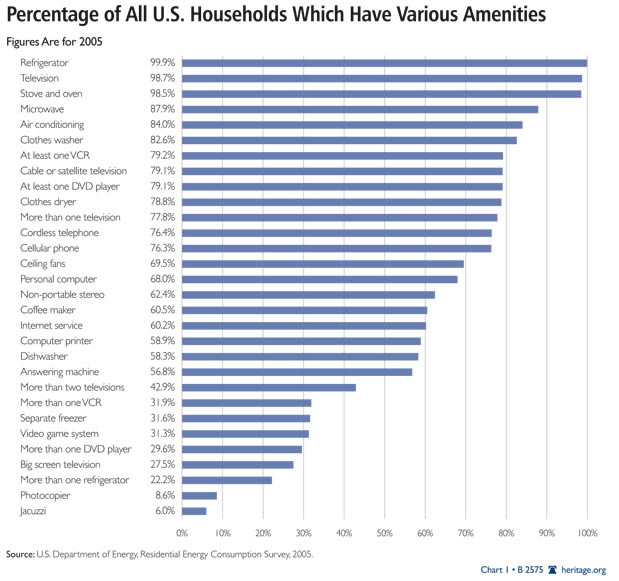
"As Congress struggles to find a way to cut spending as part of raising the $14 trillion debt ceiling, they should take a close look at the more than $1 trillion spent every year on welfare. You’ll be surprised to learn that many of the 30 million Americans defined as “poor” and in need of government assistance aren’t quite what you’d expect—rather than homeless and on the streets, the average poor American household has luxuries like air conditioning, cable TV, and X-box video game consoles....According to the government’s own survey data, in 2005, the average household defined as poor by the government lived in a house or apartment equipped with air conditioning and cable TV. The family had a car (a third of the poor have two or more cars). For entertainment, the household had two color televisions, a DVD player, and a VCR....If there were children in the home (especially boys), the family had a game system, such as an Xbox or PlayStation. In the kitchen, the household had a microwave, refrigerator, and an oven and stove. Other household conveniences included a washer and dryer, ceiling fans, a cordless phone, and a coffee maker....To be sure, the average poor family does not represent every poor family, and there are some who are better off and some who are worse off. Though most of the poor are well-housed, at any given point during the recession in 2009, about one in 70 poor persons was homeless, and one in five experienced temporary food shortages. Those individuals have serious concerns. But the fact remains that U.S. government statistics on poverty misrepresent the reality."

Source. Hertitage.org. http://blog.heritage.org/2011/07/18/morning-bell-what-is-poverty-in-america/
Read more...

Thursday, June 30, 2011

The Poor and Welfare Spending in the U.S.

Since 1964, when the War on Poverty started, the United States has spent almost $16 trillion, which is a 17-fold increase since 1964. Despite "reforms," Welfare spending continues to rise. This year alone, Welfare spending is projected to be nearly 1 trillion!

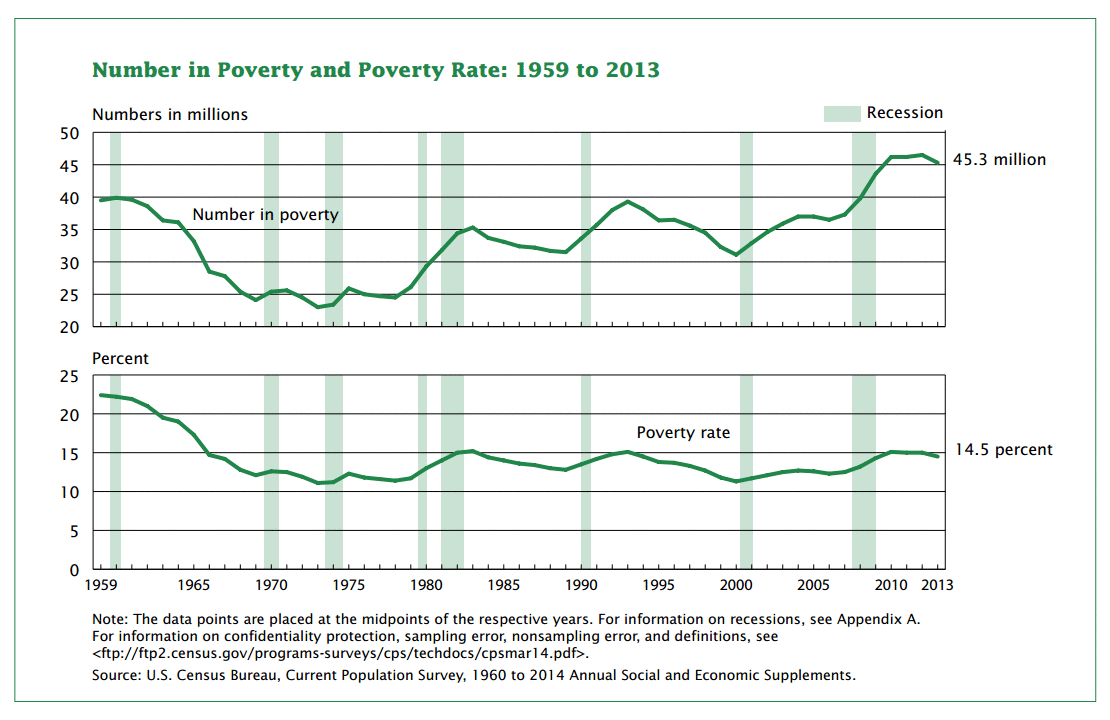
What are we getting for the money being spent? As of 2009, the United States had approximately 43 million "poor" people vs. approximately 40 million in 1959. As a result, Welfare programs have simply failed to reduce the (1) number of poor persons and (2) causes of poverty.


How Poor are the American Poor? Well, Heritage.org compiled the following facts from various government reports about persons defined as "poor" by the Census Bureau:
  • 91% of poor households have either a landline or cell phone (32% have both).
  • 43% of all poor households actually own their own homes. (The average home owned by persons classified as poor by the Census Bureau is a three-bedroom house with one-and-a-half baths, a garage, and a porch or patio. And, only 6% of poor households are overcrowded. More than two-thirds have more than two rooms per person.)
  • 80% of poor households have air conditioning. (By contrast, in 1970, only 36% of the entire U.S. population enjoyed air conditioning.) 
  • The average "poor" American has more living space than the average "non-poor" or middle class individual living in Paris, London, Vienna, Athens, and other cities throughout Europe. (Again, these comparisons are to the average citizens in foreign countries, not to those classified as poor.)
  • 75% of poor households own a car; 31% own two or more cars.
  • 97% of poor households have a color television; over 50% own two or more color televisions.
  • 78% have a VCR or DVD player.
  • 62% have cable or satellite TV reception.
  • 89% own microwave ovens, more than 50%  have a stereo, and more than 33% have an automatic dishwasher." 
As you can see, the average person defined as poor in the United States lives in a material world that is comfortable, especially when compared to the rest of the world. In the end, the growth of welfare spending is simply unsustainable and will drive the United States into bankruptcy if allowed to continue unchanged.

Source Heritage.org

Read more...

Tuesday, June 28, 2011

Making the United States Less Competitive

Nearly every industrialized country has lowered its corporate income tax over the past 20 years. However, the United States has not. This creates a less competitive environment for United States corporations.

On average, 67% of the industrialized countries have rates between 24% and 31%, which is down by nearly 16 percentage points since 1990. For example, in 1990 Germany had the highest rate (54.5%), but by 2010 it was down by over 24 percentage points.

In 1990, the United States' rate was the 16th-highest of 23 countries. Today, the United States currently has the second-highest rate (39.2%).

Source Heritage.org.

Read more...

Wednesday, June 22, 2011

The Inside Scoop on Government Unions

Read more...

Gas Price Myths

Read more...

  © Blogger templates Newspaper III by Ourblogtemplates.com 2008

Back to TOP