

Artificial Intelligence Is Taking Over Political Campaigns
-
Artificial intelligence is dominating the 2026 midterms—and not just as a
political issue. Major congressional campaigns are increasingly using
“deepfake...
Friday, December 9, 2011
Friday, November 18, 2011
Jim Rogers talks about the U.S. Economy
Here, Jim Rogers discusses how every 4 to 6 years we`ve had a slowdown or a recession in the US ever since the beginning of the republic. As a result, he believes we are overdue for one in the end of 2011, 2012 or 2013, and how it's out of bullets to do anything about it.
Monday, November 7, 2011
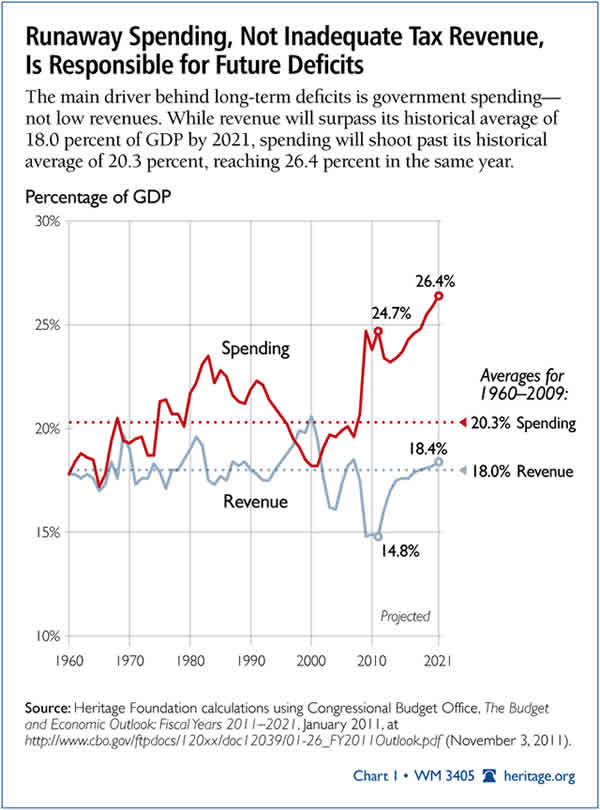
Government Spending is the Problem, Not Revenue
The November 23 deadline is nearing, and the “super committee,” created by the Budget Control Act, is still dealing with its mandate to find $1.5 trillion in deficit reduction savings. One of the ideas being tossed around is to RAISE taxes in order to reduce the deficit. But as the chart below shows, inadequate tax revenue is NOT the problem, way too much spending is.
Friday, October 28, 2011
Friday, October 21, 2011
Tuesday, October 18, 2011
Did Canada Steal Our Tenth Amendment?
By
But the Tenth Amendment has disappeared. No one has seen it in recent decades. But I’ve found some statistics that make me very suspicious that the Canadians stole the Tenth. Look at the pie charts below. The top pie shows that 71 percent of total government spending in the United States is federal, while 29 percent is state/local. (See BEA tables 3.1, 3.2, 3.3 for 2010 data).
Back when we still had the Tenth, that ratio was the other way around—like how the bottom chart looks for Canada today. In Canada, federal spending accounts for just 38 percent of total government spending, while provincial/local spending accounts for 62 percent. (See Canada Yearbook for 2010/11 data.)

Actually, the real culprit for the missing Tenth is not the Canadians, but the U.S. Congress. In recent decades, Congress has undertaken many activities that were traditionally reserved to state and local governments. A primary method has been through “grants-in-aid.” These are federal subsidies combined with regulatory controls that micromanage state and local affairs. In United States, federal grants are about 4.1 percent of GDP (in fiscal 2011), while in Canada they are about 3.3 percent of GDP.
Even more striking: while we’ve got a complex mess of more than 1,000 state grant programs, Canada seems to have just a handful, and they are simple block grants. As I understand it, Canada’s federal grants to lower governments mainly just include:
- A health care block grant
- A social services block grant
- An “equalization” block grant to help the poor provinces.
“What Can the United States Learn from Canada.” Perhaps we can learn how to get our decentralized federation back. While we’re at it, we could get some tips on how to cut government spending, as the Canadians did in the 1990s. Read more...
Friday, September 30, 2011
Economics in One Lesson - The Lesson
One of the biggest economic fallacies, committed over and over again, is ignoring the long-term, indirect consequences of a particular policy. Good economic policy analysis always means assessing a policy's impacts on all groups in the long run, rather than just the impacts on some groups in the short run.
Obama and the Solyndra Scandal
For those who are vaguely aware of the Solyndra scandal, but don’t know just how deep Obama and Biden stepped in it; here’s a quick video put out by IER (a free-market energy think tank). In short, the Obama Administration fast tracked Solyndra's loan application, and now $535,000,000 million dollars of American tax payer money is gone along with 1,000 "green" jobs.
Thursday, September 29, 2011
Citizens Have A Right To Record The Police
We all have to deal with the opportunities and challenges presented by widespread video technology. The same is true for police. But law enforcement might prefer that cameras not be a part of their interactions with citizens. Citizens should have the right to record their interactions with police and police should be required to record their most intense interactions with citizens. The video features attorneys David Rittgers and Clark Neily and journalist Radley Balko.
Friday, September 16, 2011
Saturday, September 10, 2011
Friday, August 26, 2011
U.S. Foreign Aid Does Not Translate into Votes in the U.N. General Assembly
Since World War II, these United States has engaged in an international giveaway program by spending billions of dollars each year to aid foreign nations. There is no constitutional authority for Congress to spend money in that fashion. These expenditures have won us no friends or votes, and constitute a major drain on the resources of our taxpayers.

Read more...


Friday, August 19, 2011
The Federal Budget in Terms of a Family Budget
The following is an excerpt from a letter from a Louisiana lawyer regarding the federal budget deficit. I also heard Rush talk about it on his radio program. He puts it in terms of a family budget.
The U.S. Congress sets a federal budget every year in the trillions of dollars.
• U.S. income: $2,170,000,000,000
• Federal Budget; $3,820,000,000,000
• New debt: $1,650,000,000,000
• National Debt: $14,271,000,000,000
• Recent budget cut: $38,500,000,000
To put the 2011 federal budget into perspective, let’s remove EIGHT zeros from these numbers and pretend this is the household budget for the fictitious Jones family.
• Total annual income for the Jones family for the year: $21,700
• Amount of money the Jones family spent for the year: $38,200
• Amount of new debt added to the credit card for the year: $16,500
• Outstanding balance on the credit card: $142,710
• Amount cut from the budget: $385
So, in effect, last month Congress, or in this example the Jones family, sat down at the kitchen table and agreed to cut $385 from its annual budget. What family would cut $385 of spending in order to solve $16,500 in deficit spending?
Monday, July 18, 2011
1 Trillion Is Spent on Welfare, Congress Should Cut Spending There
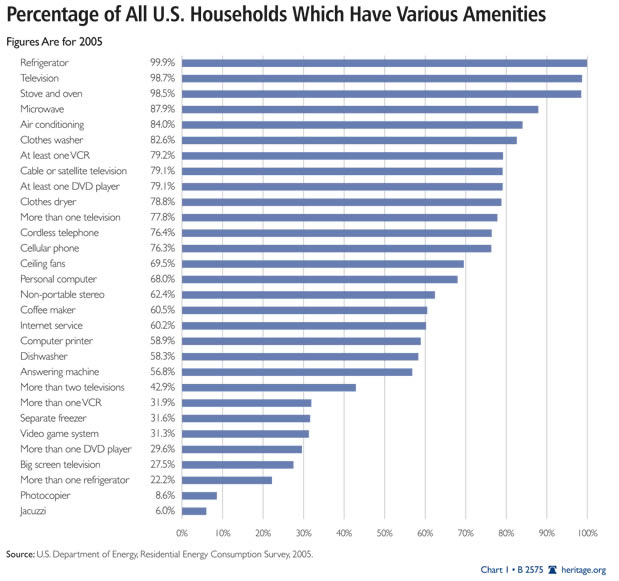
"As Congress struggles to find a way to cut spending as part of raising the $14 trillion debt ceiling, they should take a close look at the more than $1 trillion spent every year on welfare. You’ll be surprised to learn that many of the 30 million Americans defined as “poor” and in need of government assistance aren’t quite what you’d expect—rather than homeless and on the streets, the average poor American household has luxuries like air conditioning, cable TV, and X-box video game consoles....According to the government’s own survey data, in 2005, the average household defined as poor by the government lived in a house or apartment equipped with air conditioning and cable TV. The family had a car (a third of the poor have two or more cars). For entertainment, the household had two color televisions, a DVD player, and a VCR....If there were children in the home (especially boys), the family had a game system, such as an Xbox or PlayStation. In the kitchen, the household had a microwave, refrigerator, and an oven and stove. Other household conveniences included a washer and dryer, ceiling fans, a cordless phone, and a coffee maker....To be sure, the average poor family does not represent every poor family, and there are some who are better off and some who are worse off. Though most of the poor are well-housed, at any given point during the recession in 2009, about one in 70 poor persons was homeless, and one in five experienced temporary food shortages. Those individuals have serious concerns. But the fact remains that U.S. government statistics on poverty misrepresent the reality."
Source. Hertitage.org. http://blog.heritage.org/2011/07/18/morning-bell-what-is-poverty-in-america/
Thursday, June 30, 2011
The Poor and Welfare Spending in the U.S.
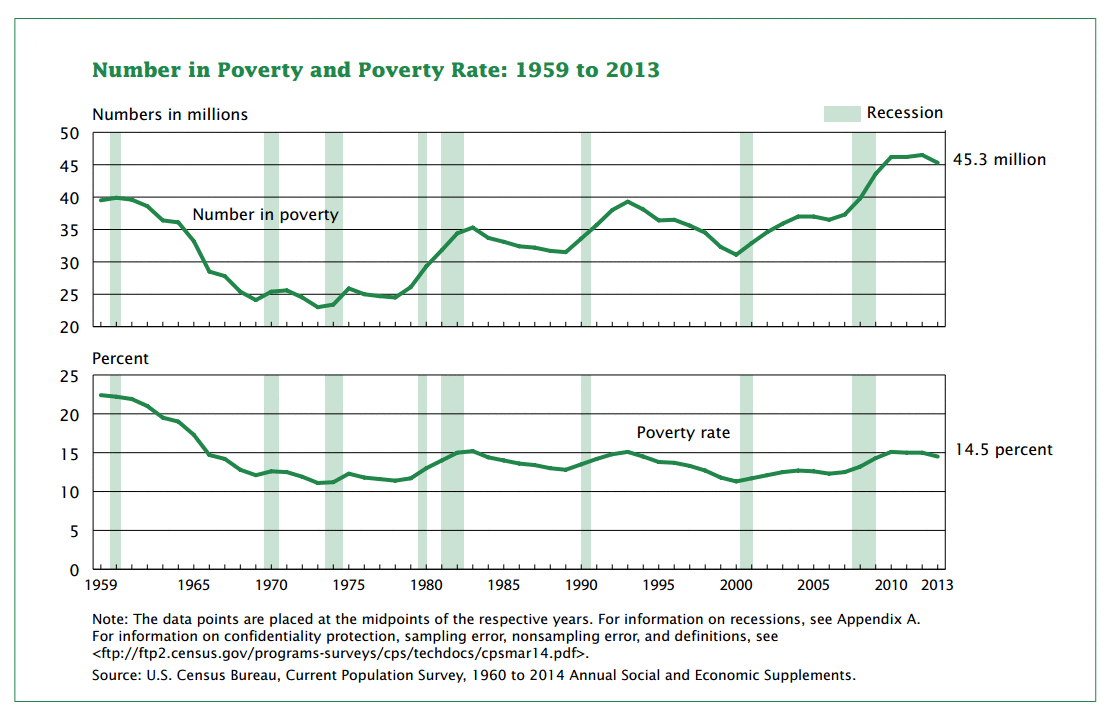
Since 1964, when the War on Poverty started, the United States has spent almost $16 trillion, which is a 17-fold increase since 1964. Despite "reforms," Welfare spending continues to rise. This year alone, Welfare spending is projected to be nearly 1 trillion!
What are we getting for the money being spent? As of 2009, the United States had approximately 43 million "poor" people vs. approximately 40 million in 1959. As a result, Welfare programs have simply failed to reduce the (1) number of poor persons and (2) causes of poverty.
How Poor are the American Poor? Well, Heritage.org compiled the following facts from various government reports about persons defined as "poor" by the Census Bureau:
- 91% of poor households have either a landline or cell phone (32% have both).
- 43% of all poor households actually own their own homes. (The average home owned by persons classified as poor by the Census Bureau is a three-bedroom house with one-and-a-half baths, a garage, and a porch or patio. And, only 6% of poor households are overcrowded. More than two-thirds have more than two rooms per person.)
- 80% of poor households have air conditioning. (By contrast, in 1970, only 36% of the entire U.S. population enjoyed air conditioning.)
- The average "poor" American has more living space than the average "non-poor" or middle class individual living in Paris, London, Vienna, Athens, and other cities throughout Europe. (Again, these comparisons are to the average citizens in foreign countries, not to those classified as poor.)
- 75% of poor households own a car; 31% own two or more cars.
- 97% of poor households have a color television; over 50% own two or more color televisions.
- 78% have a VCR or DVD player.
- 62% have cable or satellite TV reception.
- 89% own microwave ovens, more than 50% have a stereo, and more than 33% have an automatic dishwasher."
As you can see, the average person defined as poor in the United States lives in a material world that is comfortable, especially when compared to the rest of the world. In the end, the growth of welfare spending is simply unsustainable and will drive the United States into bankruptcy if allowed to continue unchanged.
Source Heritage.org
Read more...
Tuesday, June 28, 2011
Making the United States Less Competitive
Nearly every industrialized country has lowered its corporate income tax over the past 20 years. However, the United States has not. This creates a less competitive environment for United States corporations.
On average, 67% of the industrialized countries have rates between 24% and 31%, which is down by nearly 16 percentage points since 1990. For example, in 1990 Germany had the highest rate (54.5%), but by 2010 it was down by over 24 percentage points.
In 1990, the United States' rate was the 16th-highest of 23 countries. Today, the United States currently has the second-highest rate (39.2%).
Source Heritage.org.

Wednesday, June 22, 2011
Tuesday, June 21, 2011
Subscribe to:
Comments (Atom)

